

Published on: 2025-08-11

This guide demonstrates how to integrate Ollama with FastAPI and a self-hosted n8n workflow, enabling AI-powered question answering based on data scraped from Shopify documentation.
📌 Overview
The workflow leverages n8n for orchestrating tasks, FastAPI for processing requests, and Ollama for local AI model inference.
In this setup, FastAPI handles a single request that performs both embedding generation and chat-based answering, using search results gathered via the Serper API.
⚙️ Workflow Steps
1 Trigger via Webhook
A webhook initiates the process. On this workflow example:
http://localhost:5678/webhook-test/shopify-dev-scrape?question=implement+hydrogen+and+oxygen+for+theme
2 Format Search Query
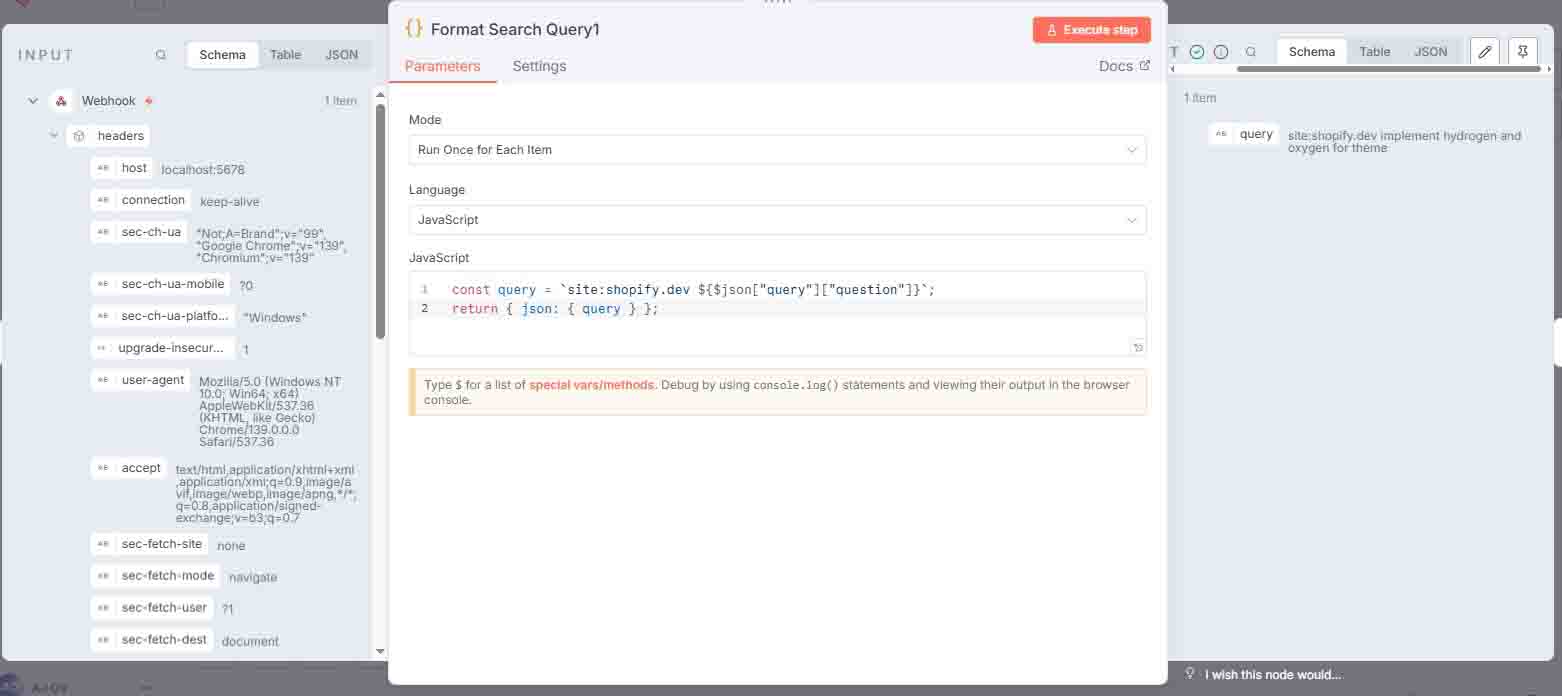
JavaScript code formats the query to target searches exclusively on the shopify.dev website.
3 Search Shopify.dev
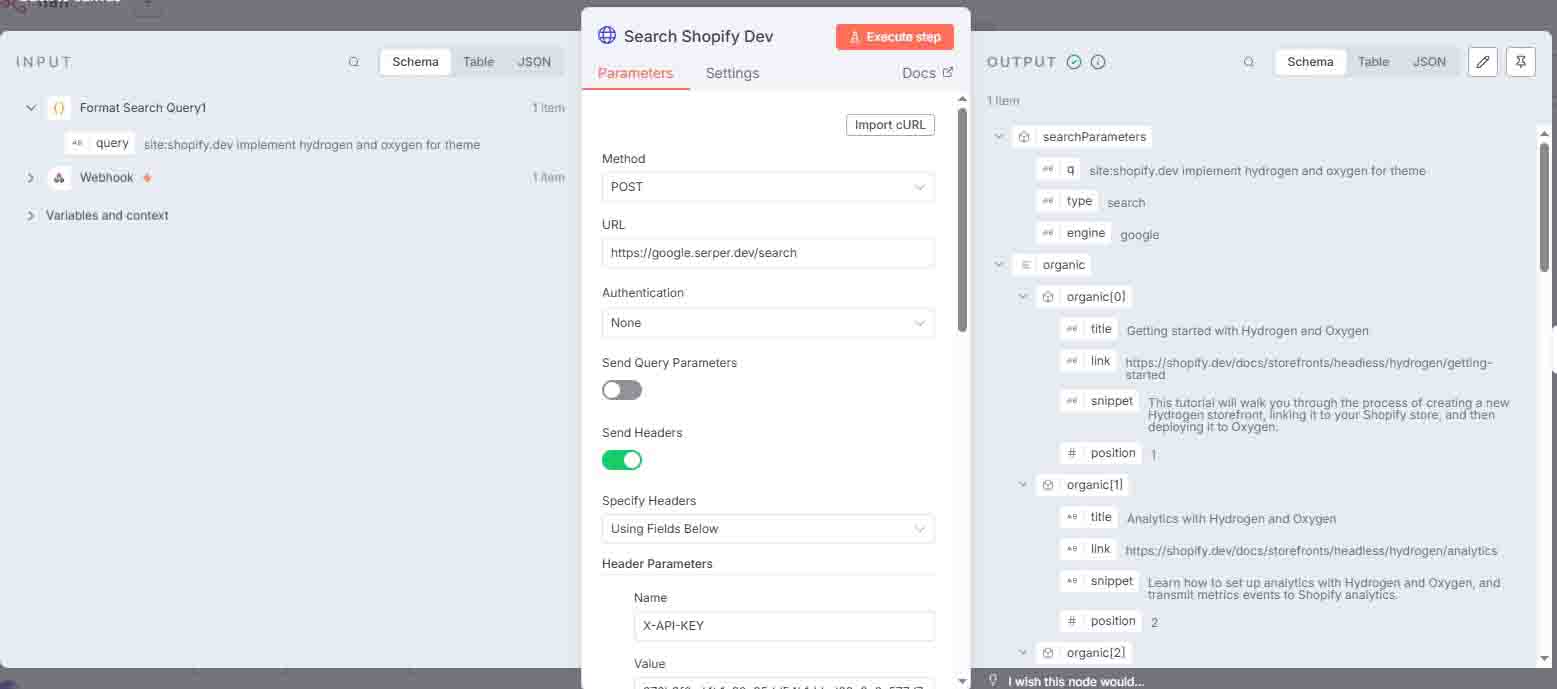
Executes a search query using Serper API (requires a free API key from serper.dev).
4 Get Top Result
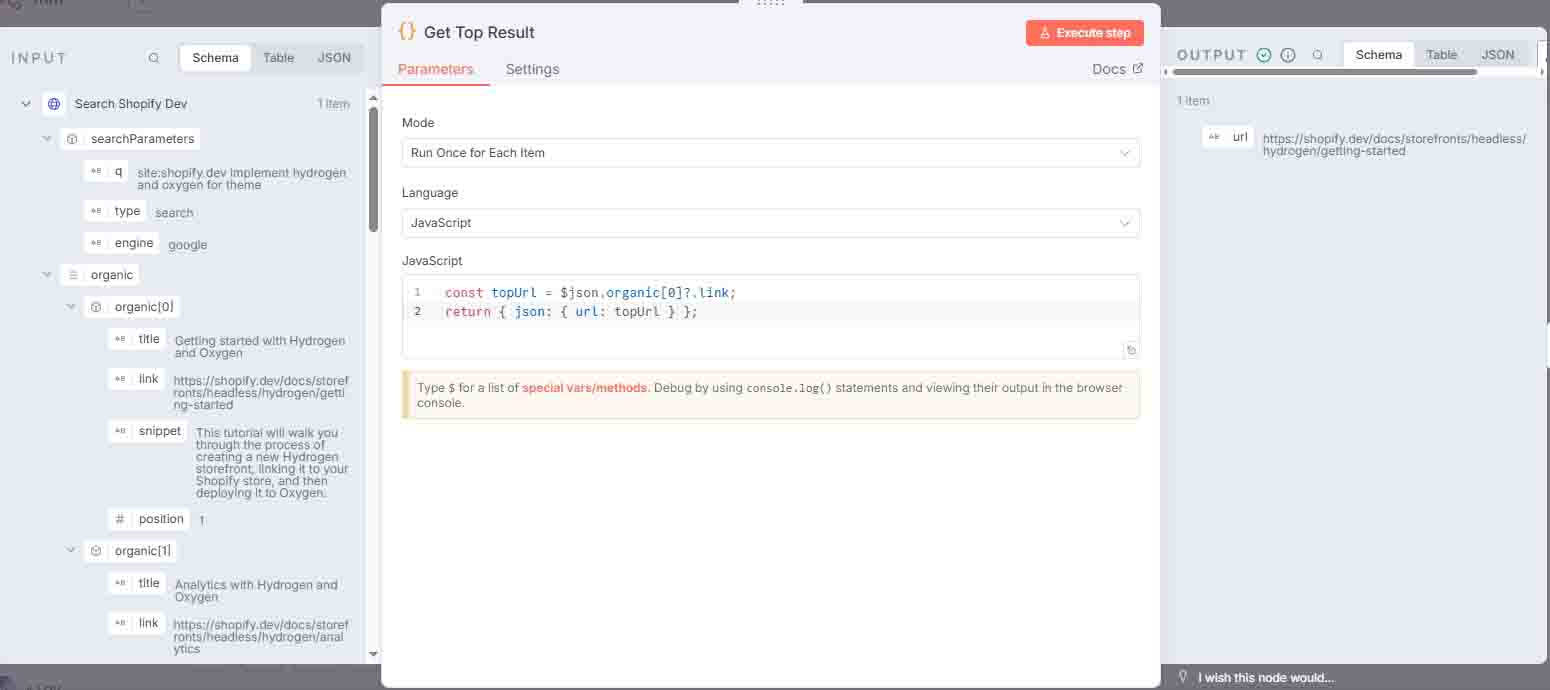
Selects only the top search result and returns it as json.url.
5 Fetch Shopify Page
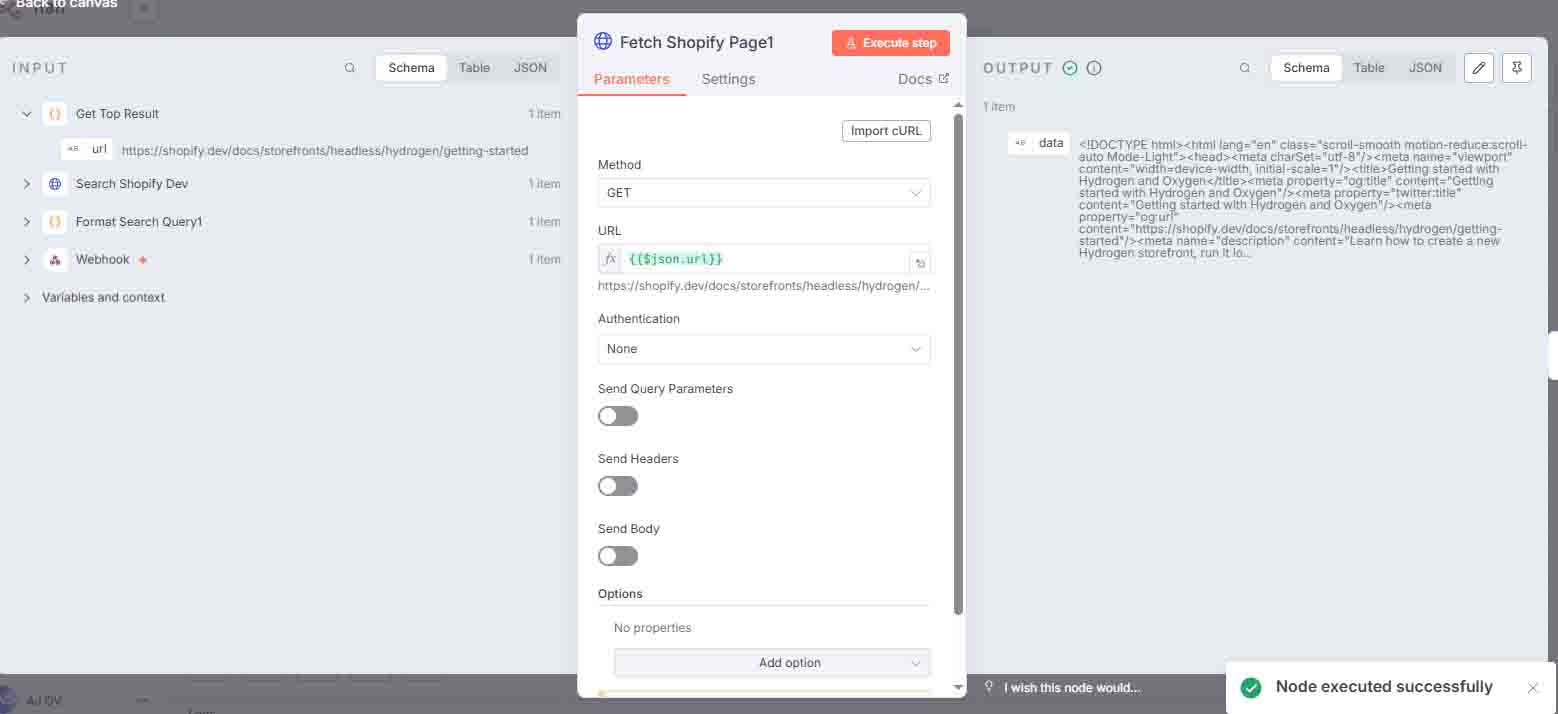
Retrieves the HTML content from the top search result.
6 HTML Extraction

Extracts specific content from the HTML body, saving it as datahtml.
7 HTML File Conversion

Converts datahtml into a file, which will be attached as a document for the “Ask Ollama” workflow.
8 Ask Ollama
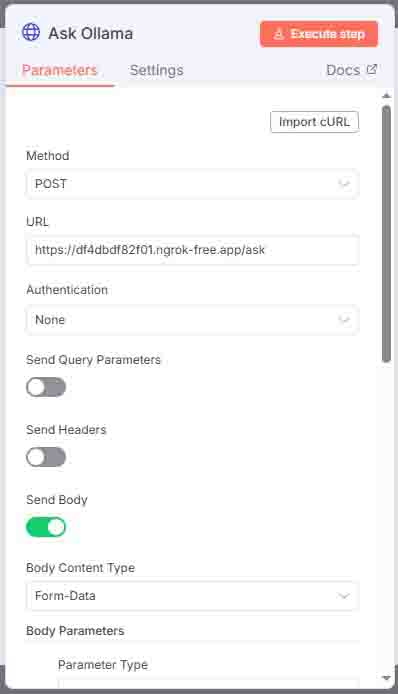
Sends the processed HTML document to the FastAPI endpoint for answering.
Requires both FastAPI and Ollama to be running via ngrok, with updated forwarding URLs.
🔹 FastAPI Setup
Python Environment Setup (Using uv):
uv venv
.venv\Scripts\activate
uv pip install -r requirements.txt
requirements.txt
fastapi
uvicorn
torch
openai
ollama
lxml
python-multipart
numpy
aiollama.py
#aiollama.py
import torch
import ollama
import re
from fastapi import FastAPI, UploadFile, File, Form
from fastapi.responses import JSONResponse
from openai import OpenAI, OpenAIError

app = FastAPI()

client = OpenAI(
    base_url='https://YOUR_FREE_PUBLIC_URL.ngrok-free.app/v1',
    api_key='dolphin-llama3'
)

# 🔹 Get relevant context
def get_relevant_context(query, vault_embeddings, vault_content, top_k=3):
    print("→ Generating embedding for query....")
    input_embedding = ollama.embeddings(model='mxbai-embed-large', prompt=query)["embedding"]
    print("✓ Query embedding done.")

    input_tensor = torch.tensor(input_embedding).unsqueeze(0)
    cos_scores = torch.cosine_similarity(input_tensor, vault_embeddings)
    top_k = min(top_k, len(cos_scores))
    top_indices = torch.topk(cos_scores, k=top_k)[1].tolist()
    return [vault_content[i].strip() for i in top_indices]

# 🔹 Main chat wrapper
def ollama_chat(
    question,
    system_message,
    vault_embeddings_tensor,
    vault_chunks,
    conversation_history,
    model_name="dolphin-llama3"
):
    print("→ Getting relevant context...")
    relevant_context = get_relevant_context(question, vault_embeddings_tensor, vault_chunks)
    print(f"✓ Got {len(relevant_context)} relevant chunks.")

    context_str = "\n".join(relevant_context)
    user_input_with_context = context_str + "\n\n" + question if relevant_context else question

    conversation_history.append({
        "role": "user",
        "content": user_input_with_context
    })

    messages = [{"role": "system", "content": system_message}] + conversation_history

    print("→ Sending request to Ollama model...")
    try:
        response = client.chat.completions.create(
            model=model_name,
            messages=messages
        )
    except OpenAIError as e:
        print("❌ OpenAIError:", e)
        raise
    except Exception as e:
        print("❌ Unexpected Error:", e)
        raise
    print("✓ Received response from Ollama.")

    # ✅ Append assistant's response to history
    assistant_reply = response.choices[0].message.content
    conversation_history.append({
        "role": "assistant",
        "content": assistant_reply
    })

    return {
        "relevant_context": relevant_context,
        "response": assistant_reply
    }
# 🔹 FastAPI Endpoint
@app.post("/ask")
async def ask_from_uploaded_html(file: UploadFile = File(...), question: str = Form(...)):
    print("→ Reading uploaded file...")
    contents = await file.read()
    print("✓ File read.")

    text = re.sub(r'\s+', ' ', contents.decode("utf-8")).strip()

    print("→ Splitting into chunks...")
    sentences = re.split(r'(?<=[.!?]) +', text)
    chunks = []
    current_chunk = ""
    for sentence in sentences:
        if len(current_chunk) + len(sentence) + 1 < 1000:
            current_chunk += sentence + " "
        else:
            chunks.append(current_chunk.strip())
            current_chunk = sentence + " "
    if current_chunk:
        chunks.append(current_chunk.strip())
    print(f"✓ Created {len(chunks)} chunks.")

    print("→ Generating embeddings for chunks...")
    vault_embeddings = []
    for i, chunk in enumerate(chunks):
        print(f"  ↪ Embedding chunk {i+1}/{len(chunks)}")
        response = ollama.embeddings(model='mxbai-embed-large', prompt=chunk)
        print(f"    • Vector: {response['embedding'][:10]}...")  # print first 5 numbers only
        vault_embeddings.append(response["embedding"])
    vault_embeddings_tensor = torch.tensor(vault_embeddings)
    print("✓ All embeddings generated.")

    print("→ Calling ollama_chat()...")
    conversation_history = []
    result = ollama_chat(
        question=question,
        system_message="You are a helpful assistant that extracts the most useful info from uploaded documents.",
        vault_embeddings_tensor=vault_embeddings_tensor,
        vault_chunks=chunks,
        conversation_history=conversation_history,
        model_name="dolphin-llama3"
    )
    print("✓ ollama_chat() complete.")
    print("Final Response:", result["response"])

    return {
        "question": question,
        "relevant_context": result["relevant_context"],
        "response": result["response"]
    }
Run the API:
uvicorn aiollama:app --reload🔹 Ollama Setup
Pull required models:
ollama pull mxbai-embed-large
ollama pull dolphin-llama3
🔹 NGROK Setup
Ollama requires traffic policy configuration to accept requests from the FastAPI server. ngrok is used to tunnel requests securely during development.
Configure ngrok traffic policy (docs):
on_http_request:
  - actions:
      - type: add-headers
        config:
          headers:
            host: localhost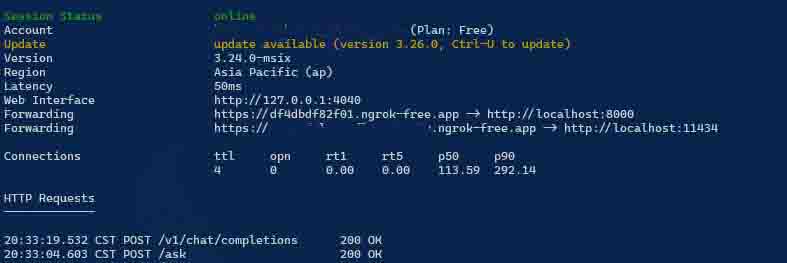
9 Respond to User
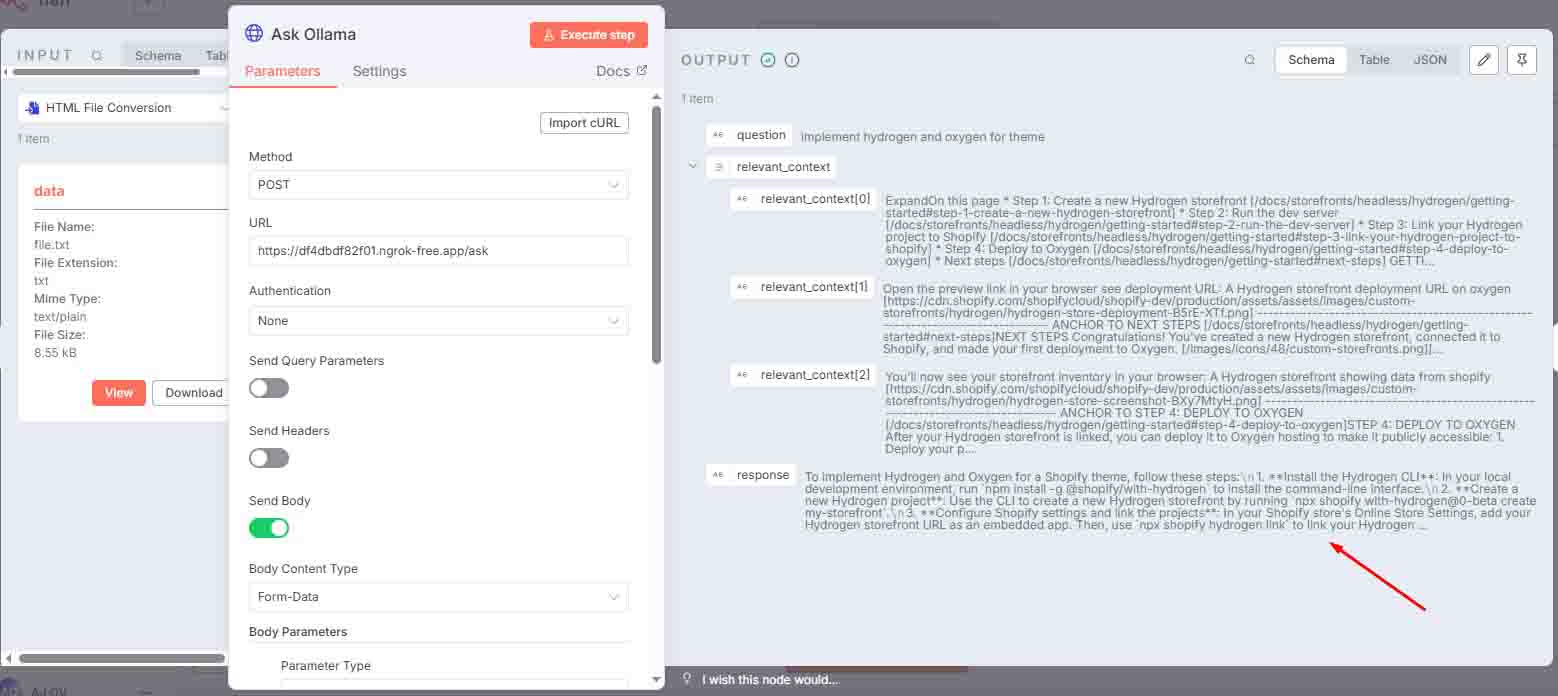
The webhook returns the AI-generated answer based on the question.
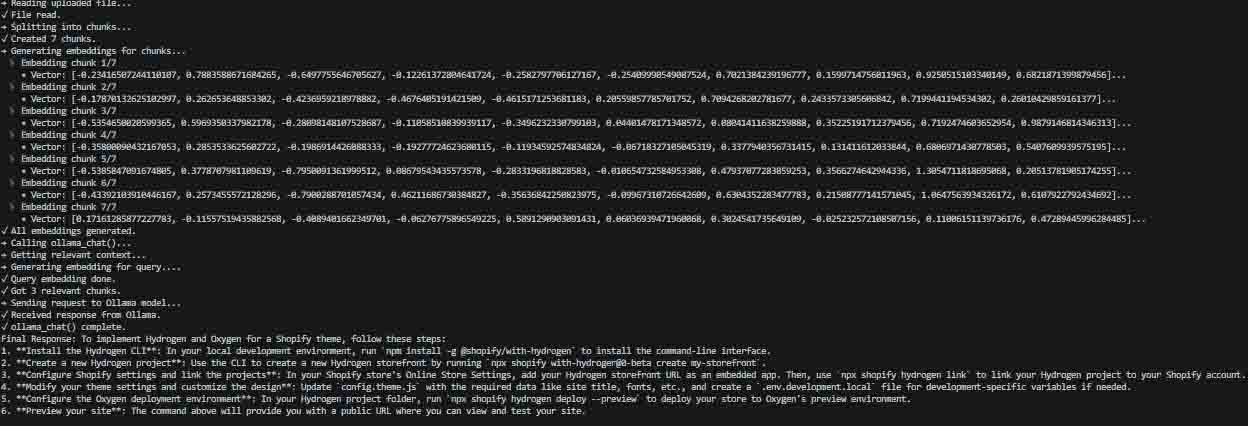
Behind the python running
Embedding:
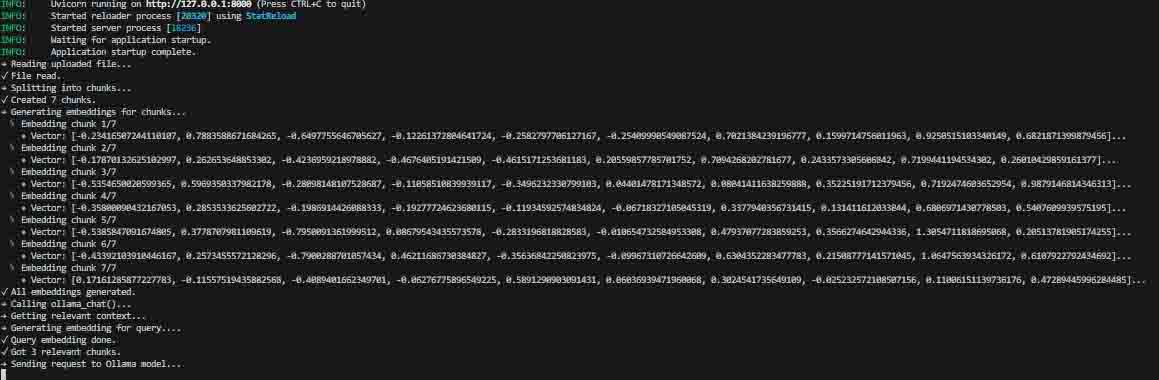
Chat API:
📄 Downloadable n8n Workflow
The n8n JSON file can be downloaded and customized. Update the configuration to match your environment. (N8N Config file)
📝 TL;DR
Integrating Ollama with FastAPI and n8n enables private, local AI workflows ideal for tasks like:
- Internal or confidential documentation search and Q&A
- Automating technical knowledge retrieval
- Building low-code AI integrations with n8n for domain-specific assistants
This approach combines local AI privacy, low-code orchestration, and flexible FastAPI endpoints for rapid AI-powered tool development.